About
Robot Learning & Machine Learning Researcher
Computer Science master's student working on assembly planning for dual-arm robots, and on making large models train and run faster.
My thesis at RISE Labs (advised by Dr. Wenlong Zhang) plans robotic assembly sequences for a 6-piece burr puzzle on a dual-arm ABB YuMi — a problem that is non-monotone with zero clearance at insertion, so it breaks the assumptions most pick-and-place planners rest on. At ASU's Knowledge Discovery & Data Mining group I worked on mode collapse in LLM reasoning and simulation-to-decision frameworks, and co-authored DELTA (ICDM 2025).
I like problems where the geometry, the learning and the systems all have to be right at once. Before graduate school I spent two years at Shell as an Analytics Engineer.
Arizona State University
VIT Bhopal University
Technical Expertise
Research Areas
Languages
Robotics & Simulation
ML Systems & Cloud
Experience
Research Experience
Graduate Research Assistant — Thesis
RISE Labs, Arizona State University
January 2025 - Present
Tempe, AZ, USA · Advised by Dr. Wenlong Zhang
- Building an assembly planning pipeline for multi-stage interlocking assembly, using a 6-piece burr puzzle as a proxy for parts that are non-monotone to assemble and have zero clearance at insertion.
- Introduced a vertex-based action space that defines moves as corner-to-corner alignments, restricted by swept-volume collision checks and bottom-support constraints that model one-gripper, two-gripper and unlimited-support budgets.
- Designed a value approximation heuristic with pruned n-step lookahead and greedy rollout, applied assembly-by-disassembly to cut the search space, and validated the resulting pick-and-place sequence in ABB RobotStudio with RAPID motion programming before transferring it to the physical ABB IRB 14000 YuMi.
- Presented initial results as Dynamic Programming in Cooperative Autonomous Assembly (with Max Gao) at the Southwest Robotics Symposium, November 2025. Now extending the framework toward full sim-to-real bimanual manipulation with robot dynamics and camera-based perception.
Graduate Research Assistant
Knowledge Discovery & Data Mining Group, Arizona State University
March 2025 - June 2026
Tempe, AZ, USA
- Investigated mode collapse in LLM math reasoning: built a synthetic-data generation pipeline with vLLM and a GRPO training environment (Qwen3-4B), analysing output diversity, reasoning trajectories and error patterns to improve dataset quality and model robustness.
- Developed a simulation-to-decision framework for supply chain optimization, integrating a Mixture Density Network, an LSTM-based simulator, and an LLM decision maker.
- Co-authored DELTA, a two-phase variational disentangled learning framework for privacy-preserving data reprogramming that combines reinforcement learning with a disentangled VAE — accepted at ICDM 2025.
Industry Experience
Associate Analytics Engineer
Shell Private Limited Company
Aug 2022 - Aug 2024
Bangalore, Karnataka, India
- Worked on large complex financial data using Alteryx and SQL databases to automate workflows which resulted in 40% reduction in the workload of the team. Built an interactive dashboard to provide a holistic view of the finances.
- Collaborated with a global team on a deep learning-based image analysis project for lube monitoring. It involved developing a python-based model for ROI detection and classification. Worked with Linux clusters to enhance workflow efficiency.
- Automated geo-mechanical experiments with python which lead to a drastic reduction in the time to generate reports by 50% per lab technician.
- Developed a process automation framework for business-critical deployments for disaster recovery involving more than 1000 applications. This led to a reduction in the workload of 3 business days per team member.
- Developed an interactive dashboard to track 150+ business continuity services, including disaster recovery and enterprise recovery for business-critical applications.
- Collaborated with 20+ application owners, stakeholders, and vendors to ensure the seamless execution of the disaster recovery process being a disaster recovery focal point.
Publications
My recent research publications in peer-reviewed conferences and journals.
DELTA: Variational Disentangled Learning for Privacy-Preserving Data Reprogramming
ICDM - International Conference on Data Mining, 2025
A two-phase variational learning framework for privacy-preserving feature transformation, combining reinforcement learning with a disentangled VAE. Demonstrated robust performance across eight real-world datasets, improving downstream task utility while reducing sensitive attribute leakage.
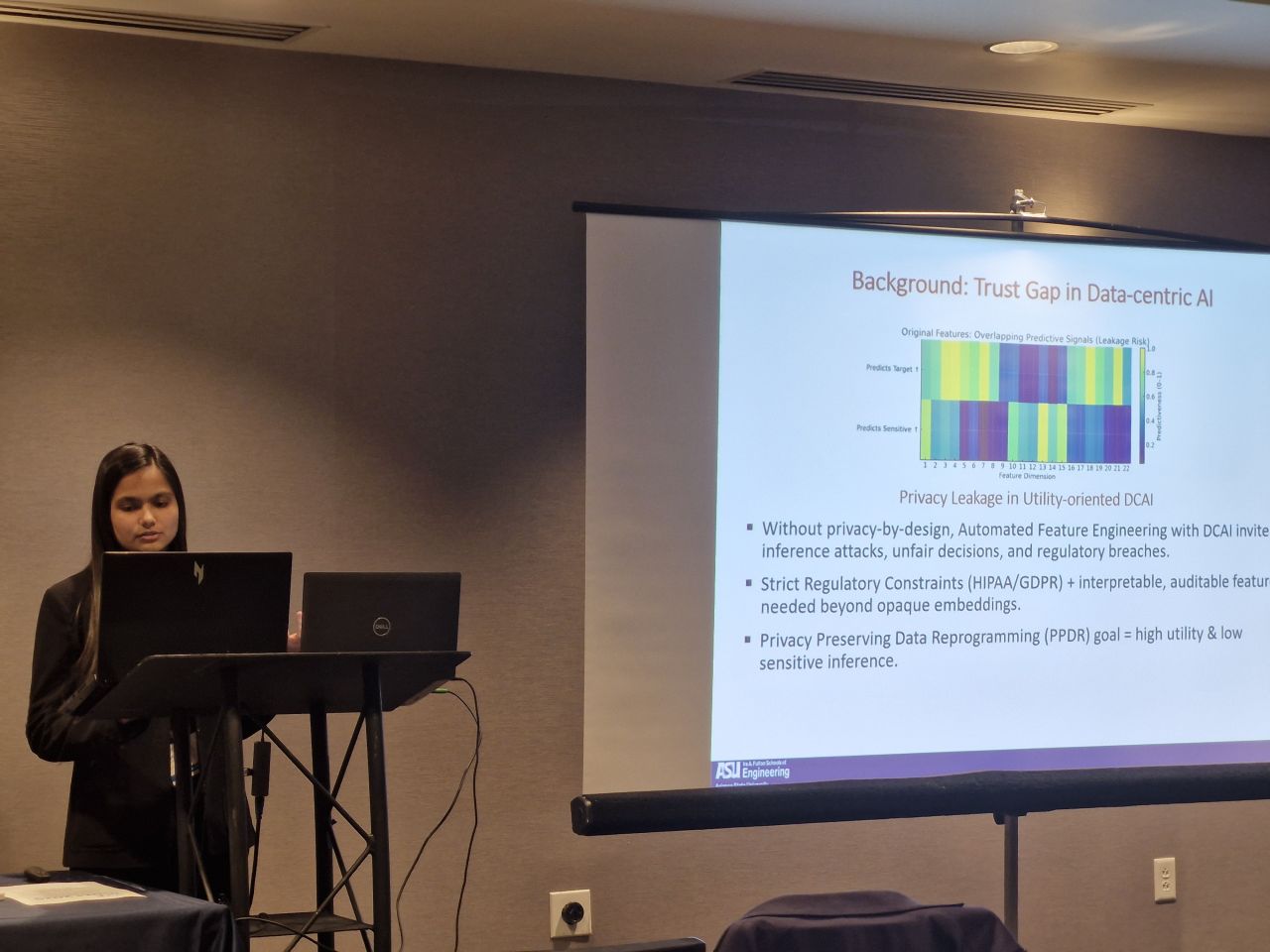
Presenting DELTA at ICDM 2025.
Advanced Deepfake Detection Using Inception-ResNet-v2
International Conference on Communication and Intelligent Systems, 2023
A deepfake detection pipeline combining MTCNN-based face extraction with Inception-ResNet-v2 and custom dense layers in a sequential model, reaching 91.41% accuracy on the DFDC dataset with an interactive GUI.
Patents
Intellectual property from my research and development work.
MITRA: Marine Inspection Tool for Rating and Assessment
Shell PLC | Filed: 2024
An innovative solution in lube monitoring that uses deep learning for image classification with 90% accuracy. The project - Shell LubeMonitor leverages deep-learning, high-resolution image analysis and a vast engine data archive to provide granular insights and early warnings. It is already helping over 500 ships daily stay ahead of performance issues.
Patent Pending
Projects
Robot Learning & Assembly Planning
Assembly Planning with the Burr Puzzle Thesis
January 2025 - Present · RISE Labs, ASU
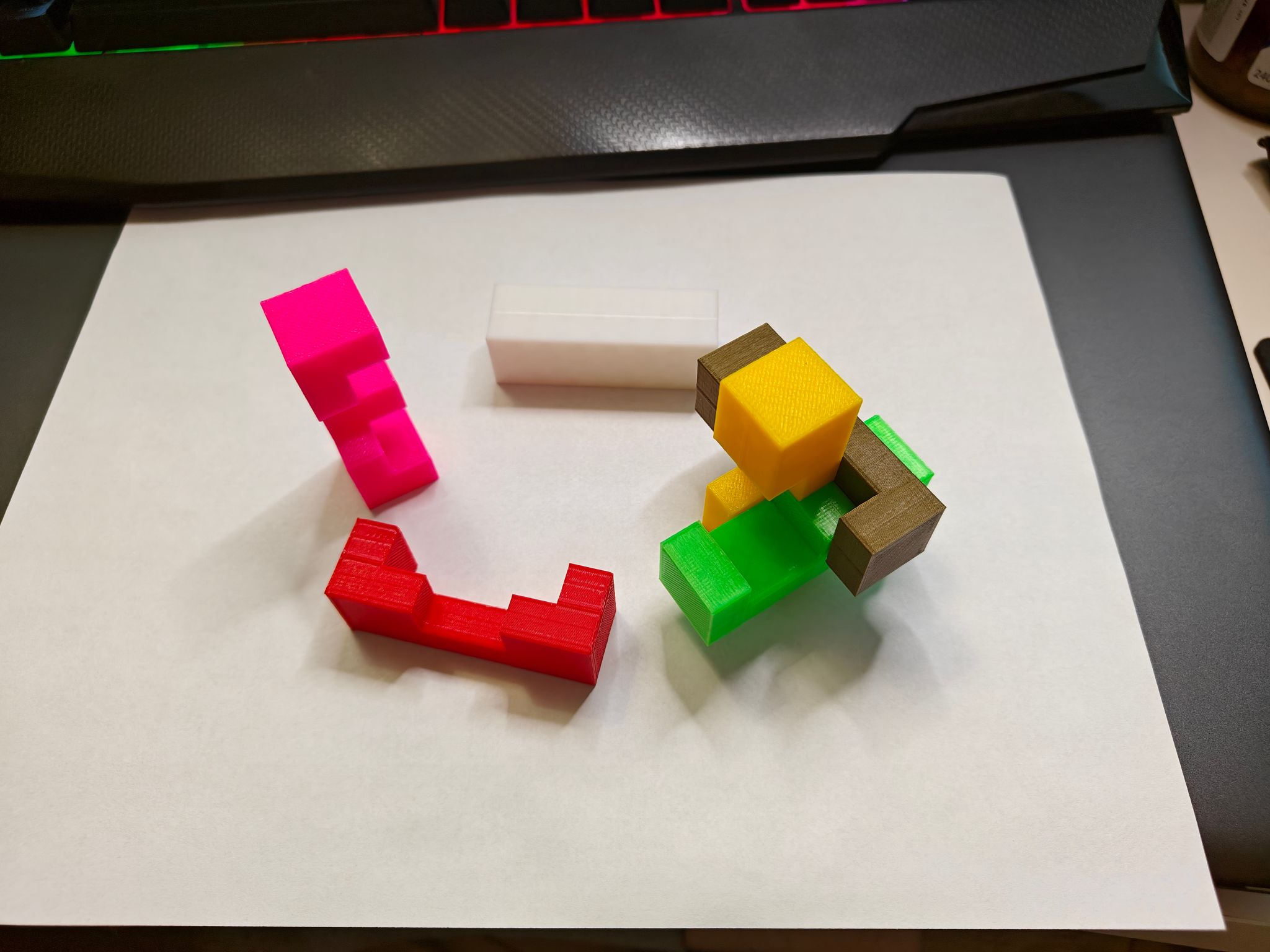
A 6-piece burr puzzle is a hard assembly instance: it is non-monotone and its clearances are zero at insertion. This thesis plans a full assembly sequence for a dual-arm ABB YuMi using a corner-to-corner action space and a pruned-lookahead search that plans the disassembly and reverses it, validated in ABB RobotStudio and transferred to the physical robot.
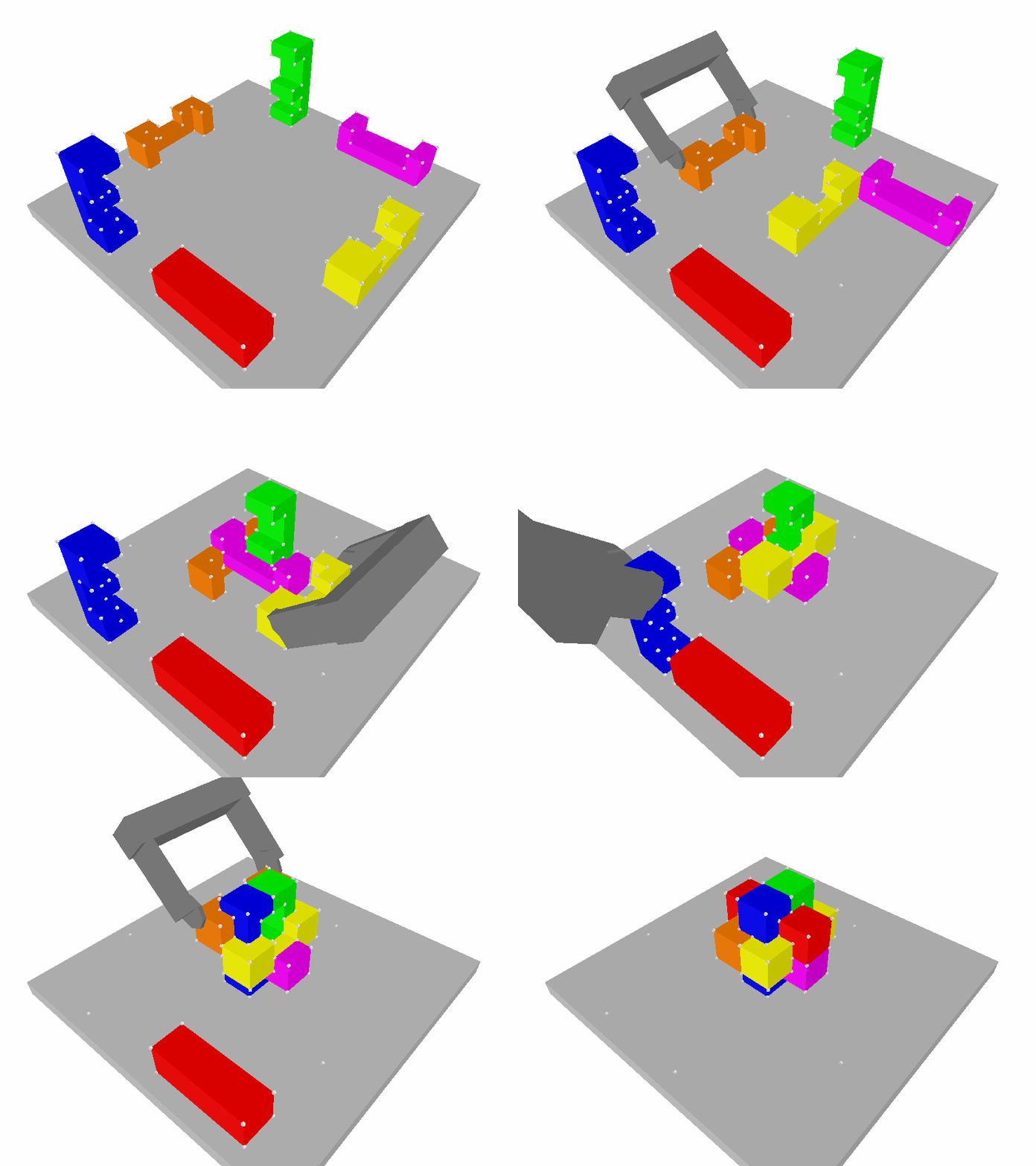
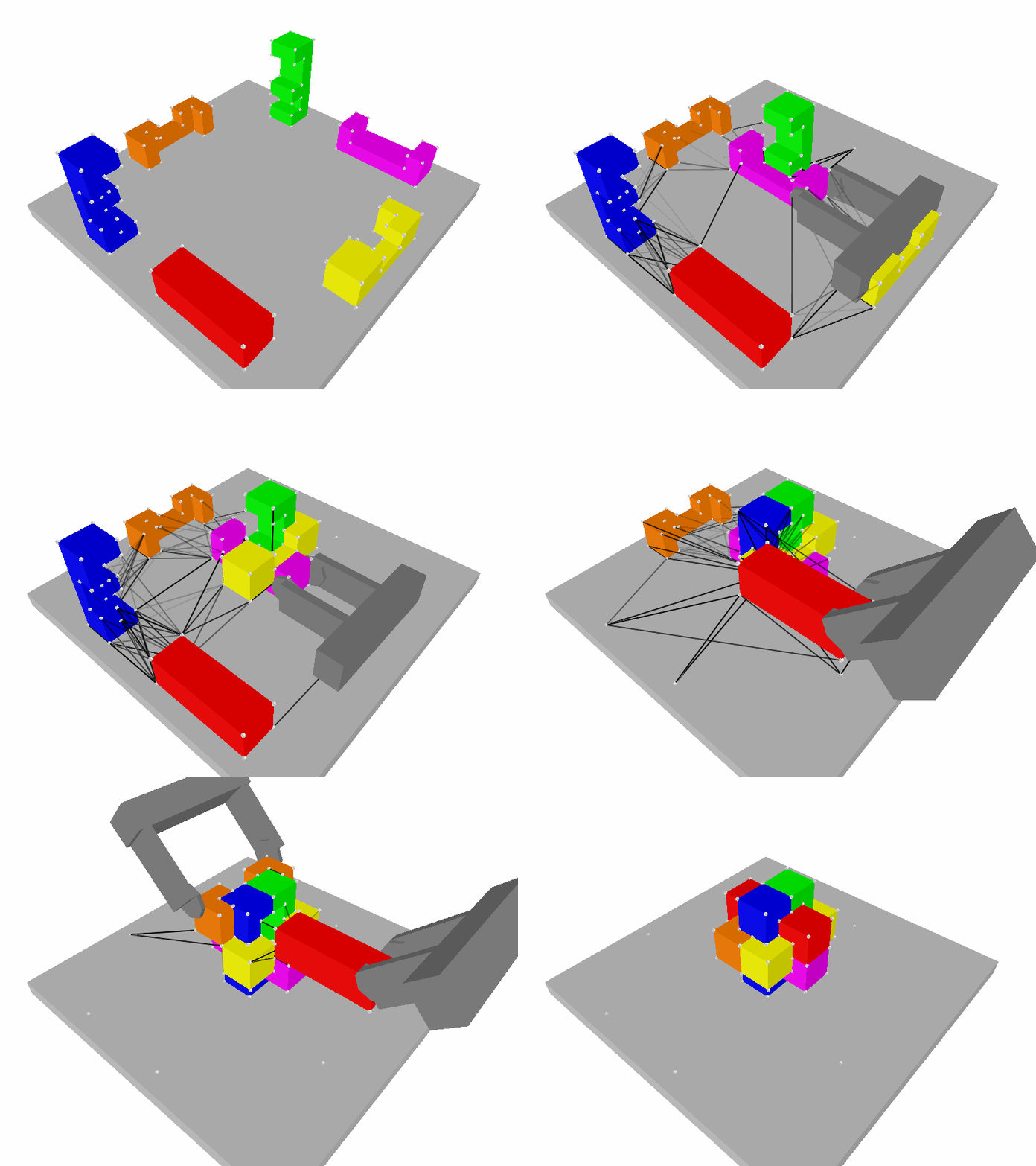
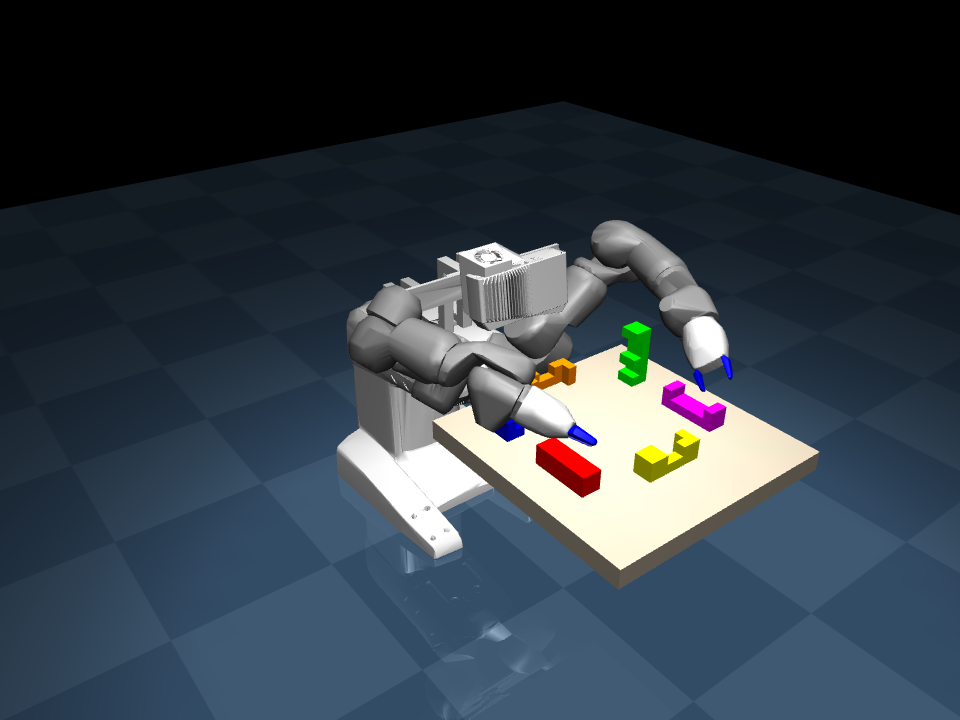
Planned assembly under a one-arm (left) and two-arm (right) support budget.
The action space
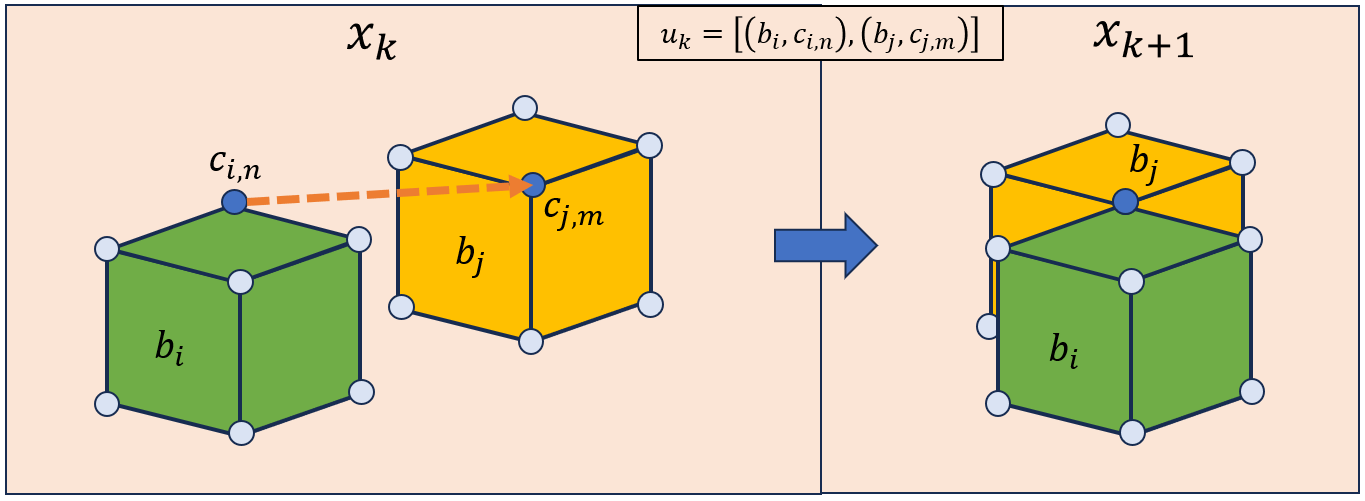
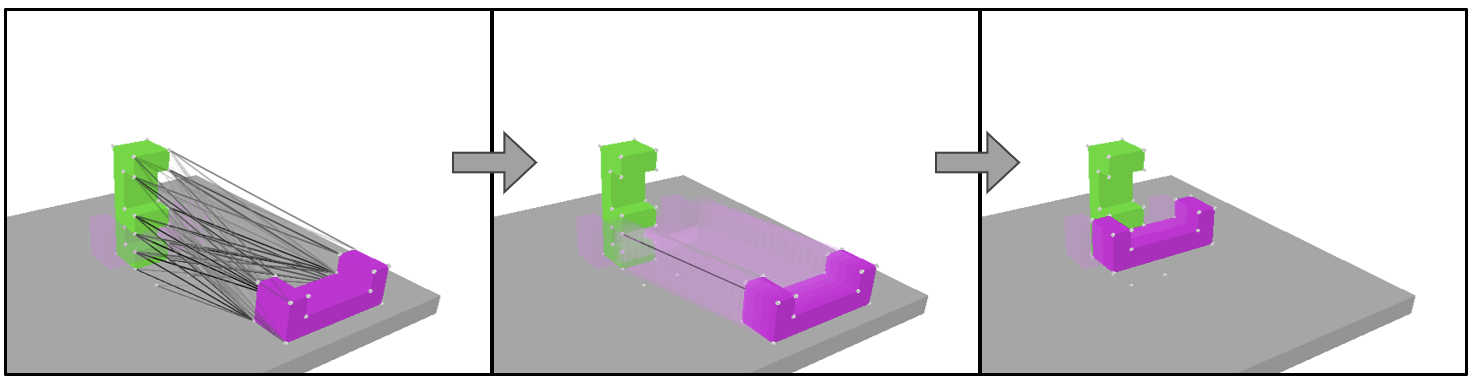
For each piece the planner extracts vertices where three mutually orthogonal edges meet, and an action translates the moving piece linearly until a chosen pair of corners coincides — a discrete, geometry-derived action space rather than a sampled one. Feasibility is decided by interpolating along the translation and collision-checking against every other active piece, plus a bottom-support test and an arm budget that models one gripper, two grippers, or unlimited support.
The search
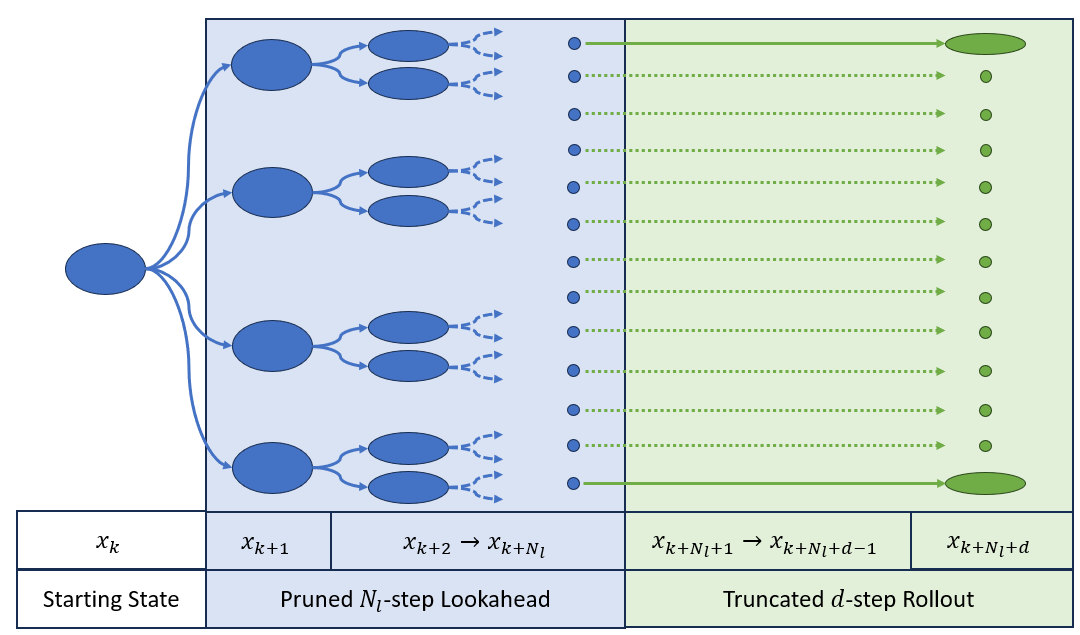
From each state the branch tree is pruned at every level, expanded for an n-step lookahead, and each surviving branch finished with a truncated greedy rollout; the move with the best cumulative score is committed. Accepting short-term sub-optimal moves this way is what rescues the goal-distance heuristic from the interlocking structure that traps a purely greedy planner.
Assembly by disassembly
The sequence is searched backwards from the interlocked goal and then reversed, because disassembly is the easier direction: every removal moves away from a fully constrained pose, while assembly must find the one entry order that does not deadlock. Plans were generated for one-, two-, and unlimited-arm budgets, with more arms reducing the number of required actions.
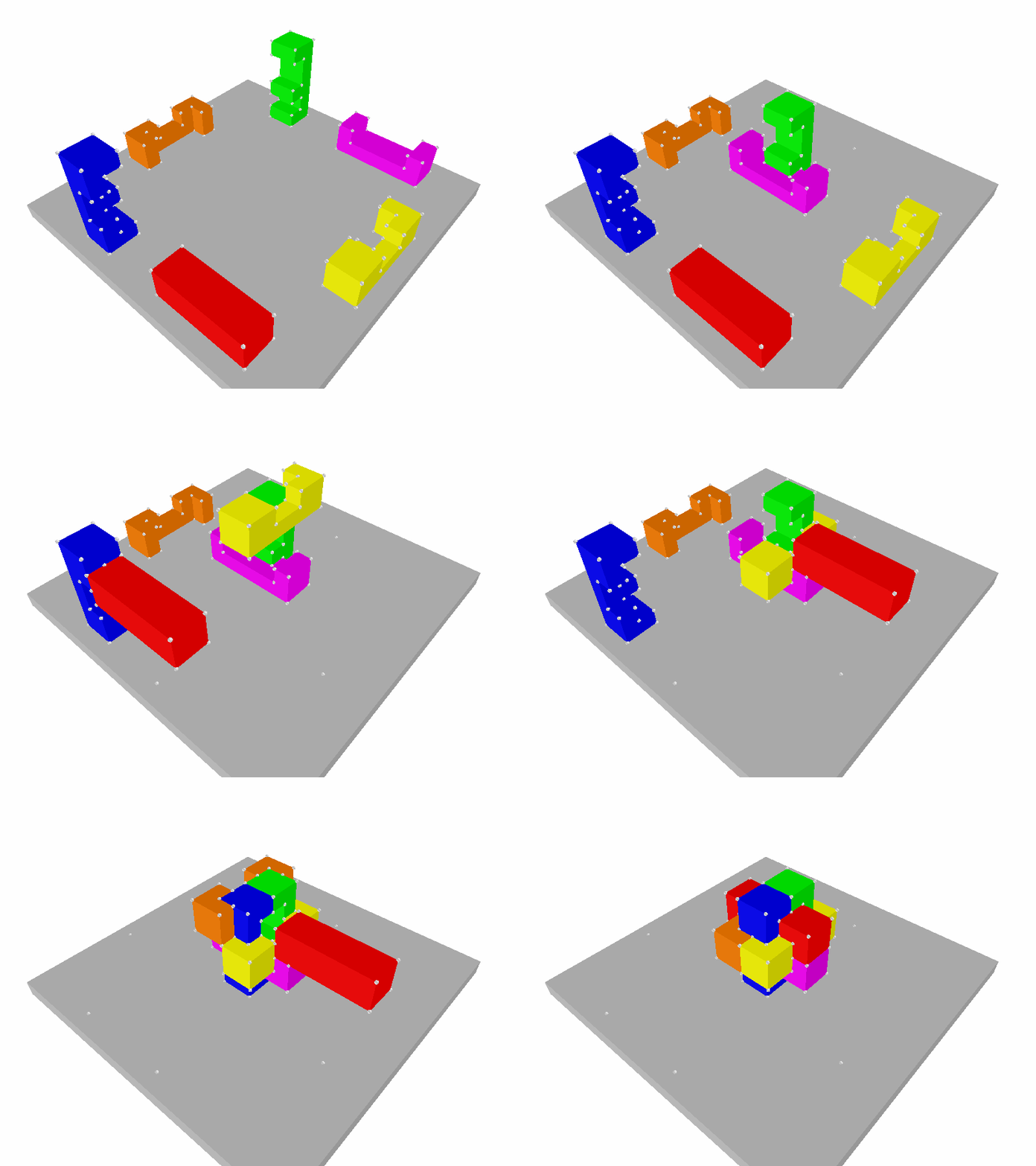
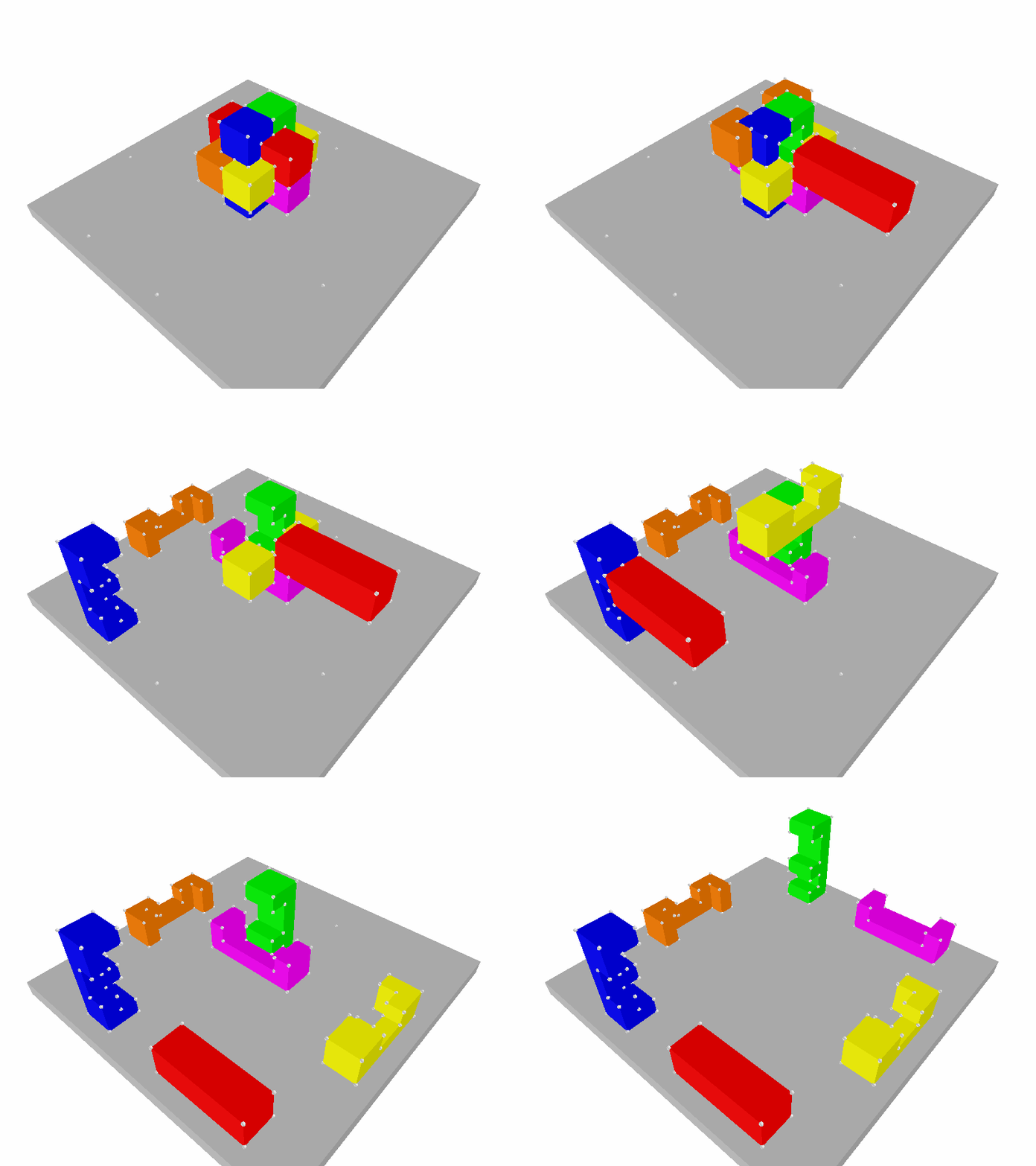
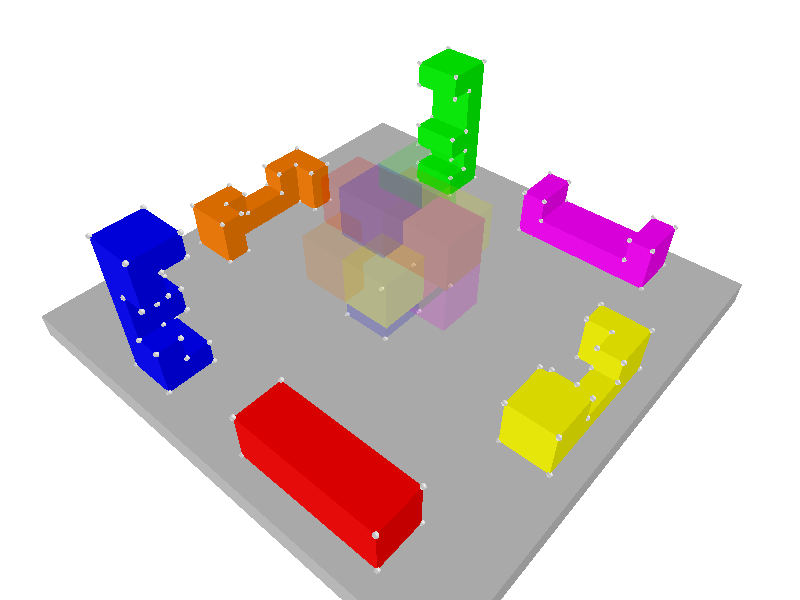
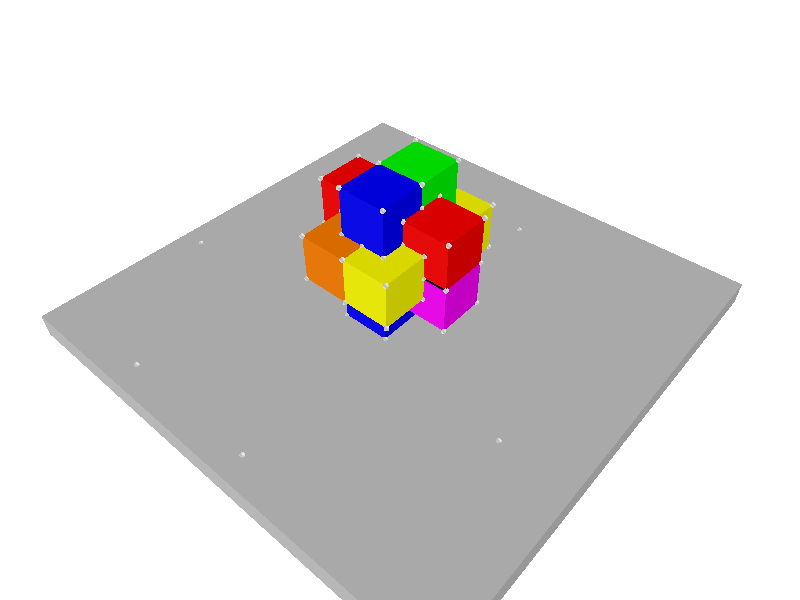
From simulation to the robot
The pick-and-place sequence was validated in ABB RobotStudio with RAPID motion programming and transferred to the physical ABB IRB 14000 YuMi. A MuJoCo scene converted from the real robot's URDF (32 bodies, 60 DoF, 16 actuators) carries the six pieces as free bodies for headless rollout. Current work brings gripper access, arm collision and reach into the scoring itself, so a move no arm can perform is rejected at the stage that proposed it.
Southwest Robotics Symposium 2025
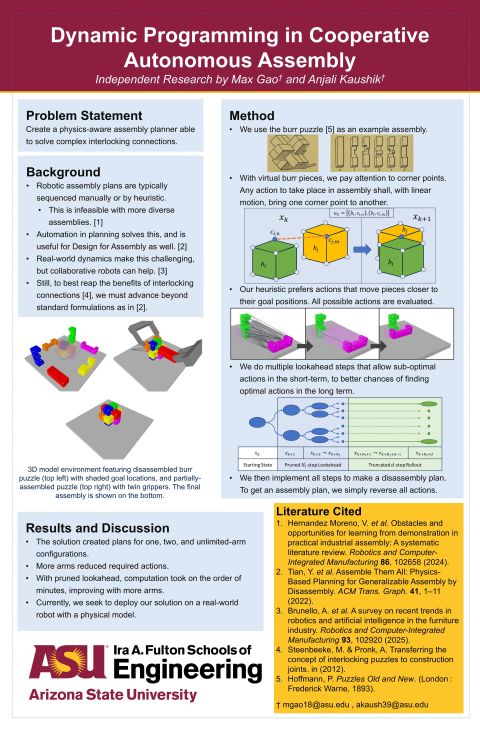
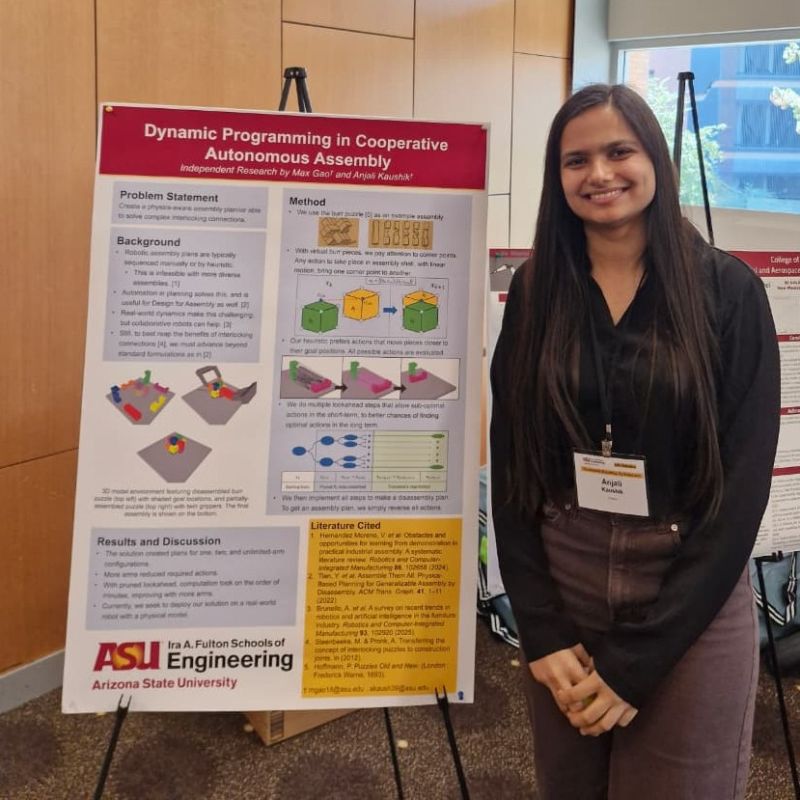
Presented Dynamic Programming in Cooperative Autonomous Assembly, independent research with Max Gao, arguing that manually sequenced or heuristic assembly plans do not scale to diverse assemblies and that interlocking connections need a formulation reasoning directly about geometry and support. A parallel study asks whether a language model, given solved sub-puzzle traces in context, can propose feasible moves without search — write-up in progress.
Robotic Chess Player using Foundation Models
May 2025 - August 2025
Converted chess games in PGN notation into robot demonstrations, using a state machine and operational space control with a UR5 manipulator to play the games on a board in MuJoCo, then fine-tuned the Pi0 vision-language-action model on them.
Door-Opening Policy with TD3
June 2025
TD3 agent implemented from scratch in PyTorch — twin critics, delayed and soft target updates, action smoothing, replay buffer — trained to open a door with a Franka Panda arm in robosuite under joint-velocity control.
LLM Systems, Inference & Data
FlashAttention for Llama Inference, in Triton and CUDA
January 2025 - May 2025 · CSE 524, Machine Learning Acceleration
A hand-written Triton kernel that tiles Q/K/V into SRAM and fuses matmul → softmax → matmul into one pass, dropped into a Llama decoder block. Measured ~4× faster inference and >10× better memory traffic, bandwidth use and arithmetic intensity against a naive baseline.
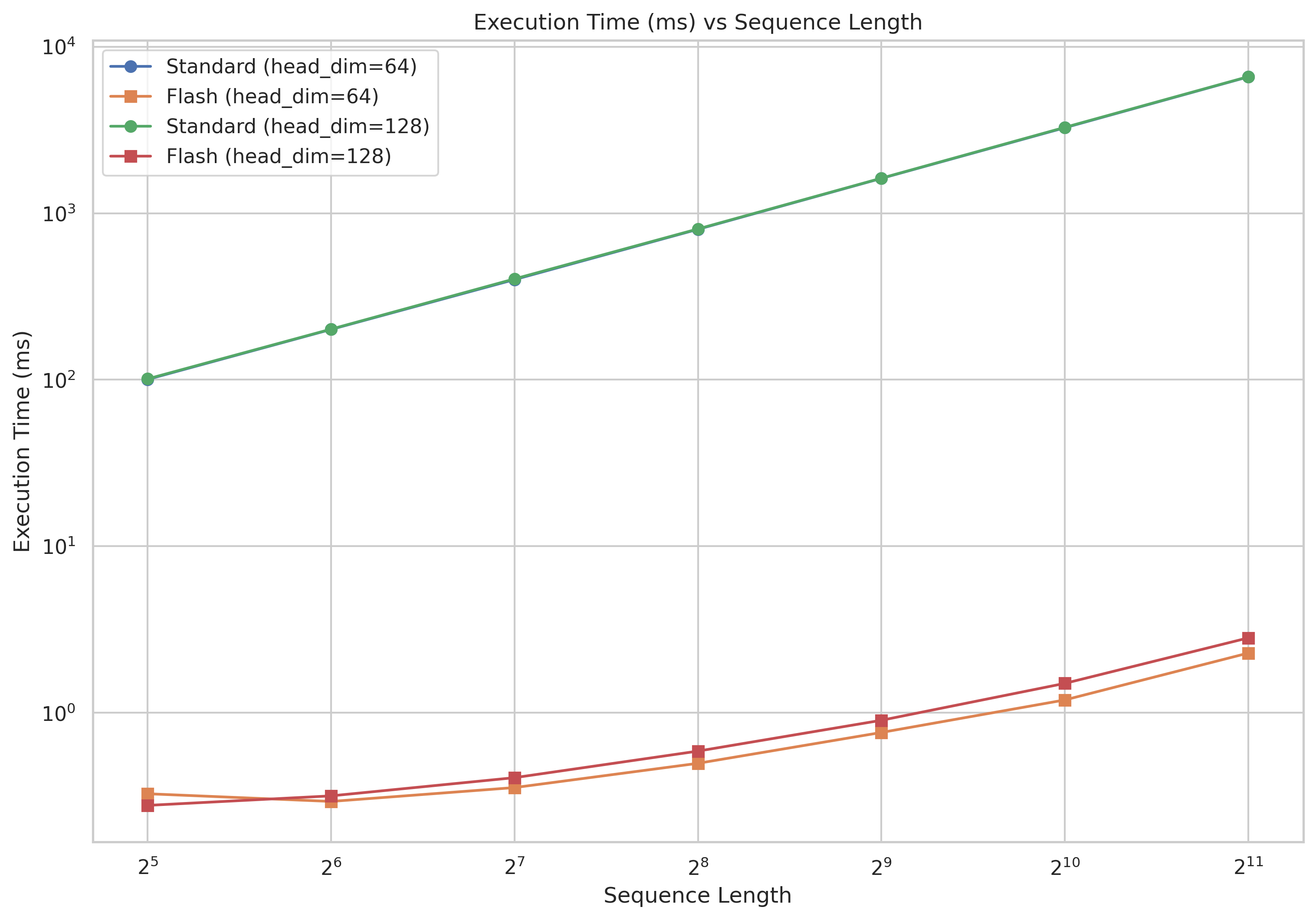
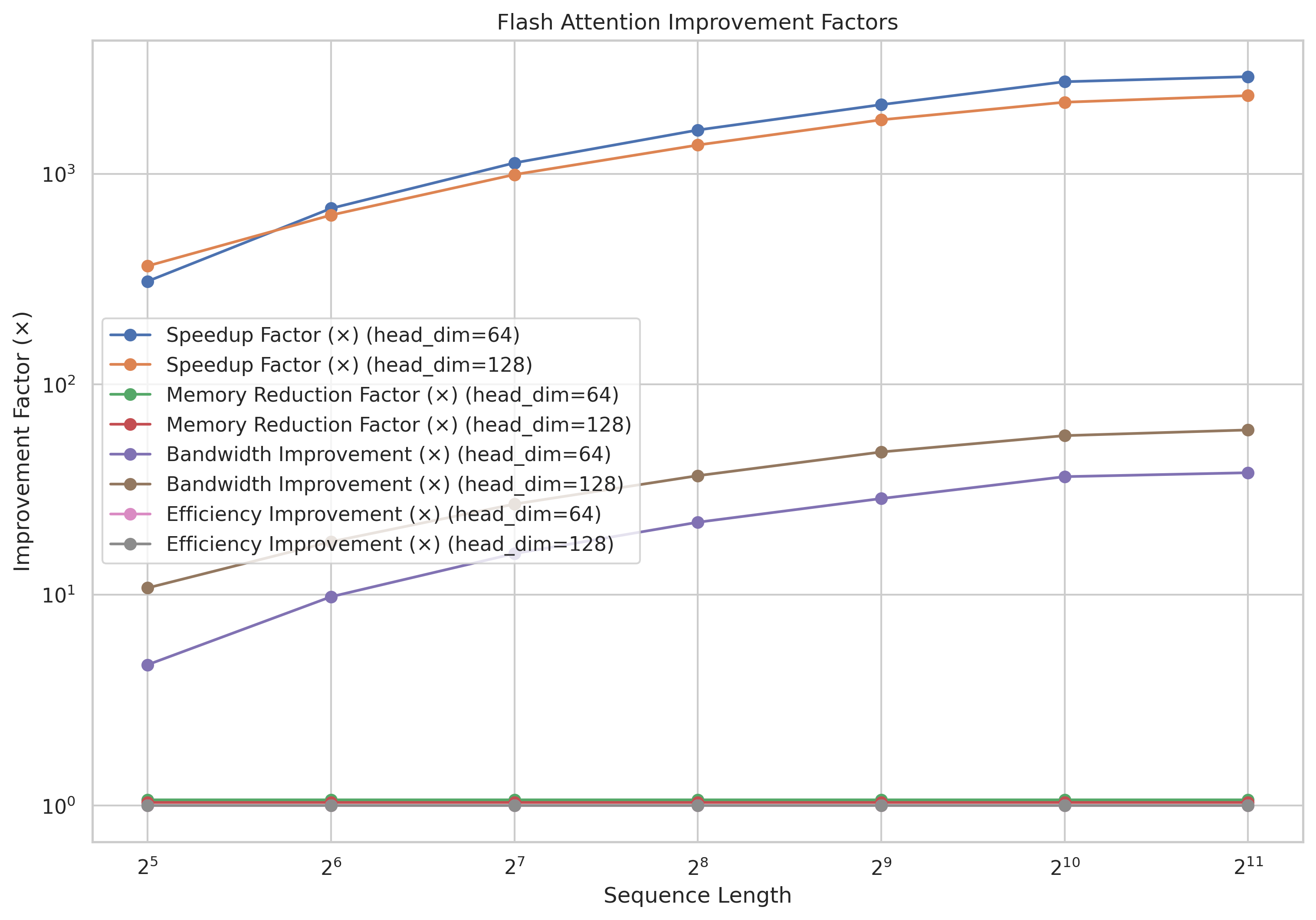
Inference latency and improvement factors, flash vs. standard attention.
Attention is memory-bound, not compute-bound
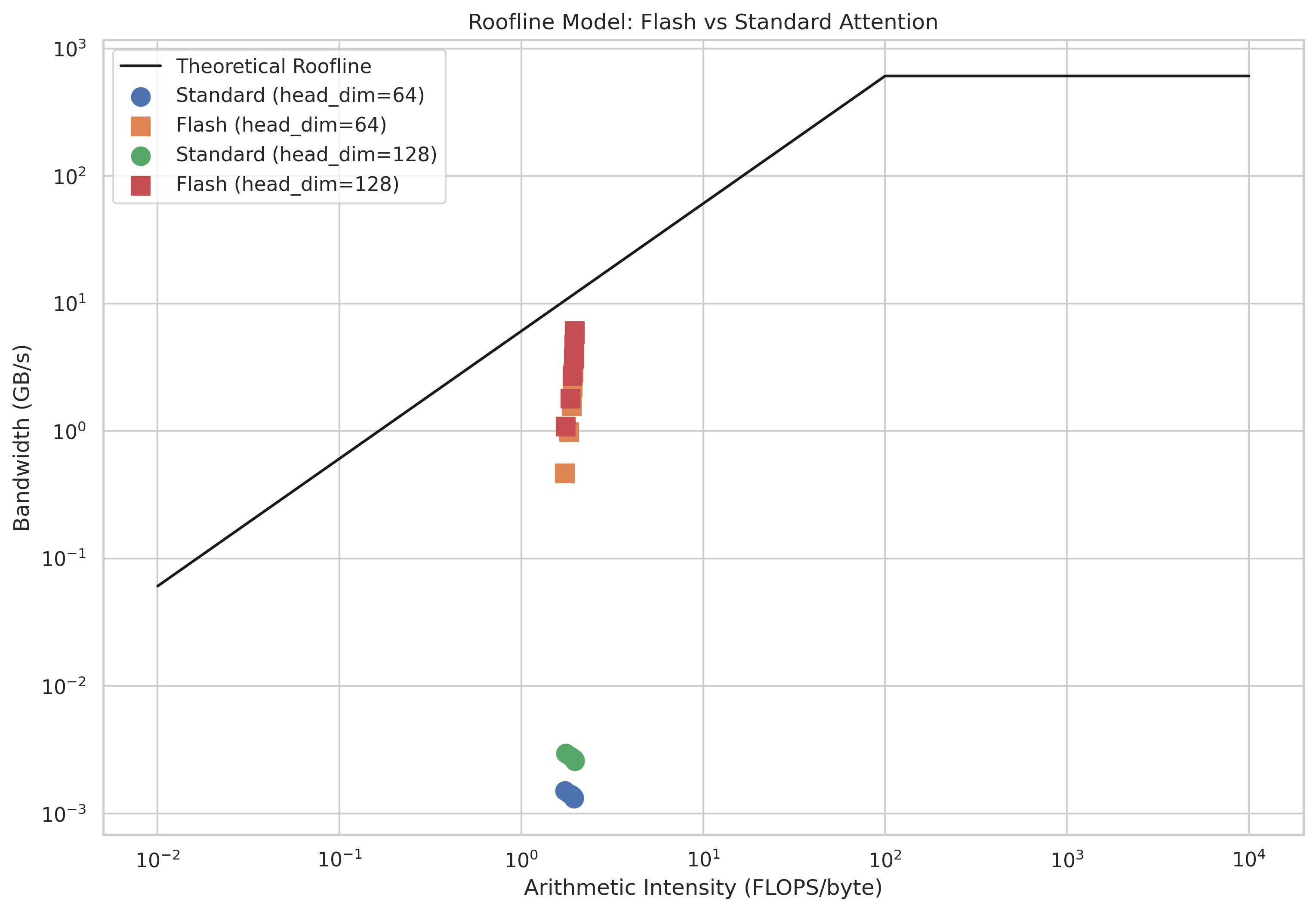
A naive implementation computes the full N×N score matrix, writes it out to HBM, reloads it to apply softmax, writes it back, and reloads it once more for the second matmul. On-chip SRAM runs at roughly 19 TB/s against HBM's 1.5 TB/s, so the GPU spends its time waiting on memory rather than computing.
Tiling, fusion and online softmax
FlashAttention tiles Q, K and V into blocks small enough for SRAM and fuses the whole pipeline into one kernel, so intermediates never round-trip through HBM. The catch is that softmax is a reduction over the whole row. The online softmax algorithm solves it by keeping a running max and normalizer per query row and rescaling the accumulated output whenever the running max shifts — giving a result mathematically identical to standard softmax attention while only ever holding one tile.
Dropping it into Llama
Llama's decoder block adds grouped multi-query attention and a KV cache around RMSNorm, RoPE and SwiGLU. This project swaps only the attention sub-block for a @triton.jit kernel that streams over cached K/V one token at a time, leaving everything else untouched, and benchmarks it against a naive baseline on a 15M-parameter Llama2-architecture model trained on TinyStories. Tested on ASU's Sol cluster (NVIDIA A100) and locally on an RTX 4060.

Perf-Analyze — Inference Performance Explorer Live demo
June 2025
A tool that turns raw LLM inference performance sweeps into decisions for two audiences at once: a go/no-go signal for customers, and config sensitivity for engineers. Any conforming sweep renders live on upload — including models the app has never seen.
Statistically Representative Benchmark Pruning
June 2025
Cut three evaluation benchmarks (LiveCodeBench, AA-LCR, MMMU) to small subsets that preserve model rankings and difficulty distribution, by stratifying on pass rate and spectrally clustering problem-text embeddings within each stratum.
Two audiences, one dataset
The projections normally live in a spreadsheet only performance engineers can read, so a customer-facing PM has to decode column names before anyone can act. The tool serves both sides from the same upload: a customer view with a go/no-go signal against user-defined requirements, a ranked throughput bar, a performance frontier scatter of throughput against time-to-first-token, and a model × workload heatmap; and an engineer view with throughput distribution, relative metric comparison, scaling efficiency, config sensitivity curves and a t-SNE cluster map.
Built as a tool, not a page
Eleven models pre-load at startup, but the file-and-column shape is the only contract — upload a sweep for a model the app has never seen and it renders live, with no rebuild and no code changes. Built with Gradio, pandas and Plotly, deployed on Hugging Face Spaces.
OpenArm 2.0 — Robot Data Pipeline & VLA Fine-Tuning
July 2025 - August 2025
An end-to-end pipeline over 50 bimanual teleoperated demonstrations: audit the data, design a labeling schema, curate it into a valid LeRobotDataset, design an evaluation protocol, and fine-tune OpenVLA-7B both with LoRA and full-parameter. Checkpoints published to the Hugging Face Hub.
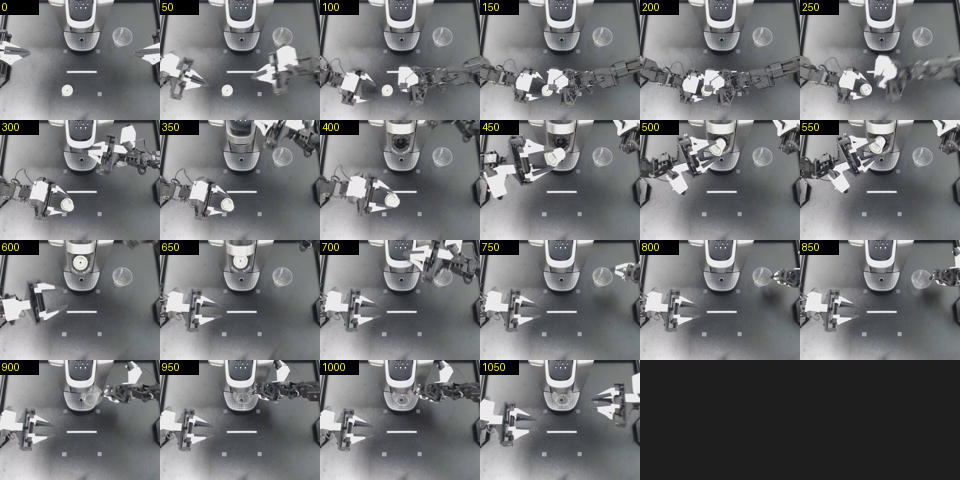
One bimanual coffee-making episode as a contact sheet.
Audit
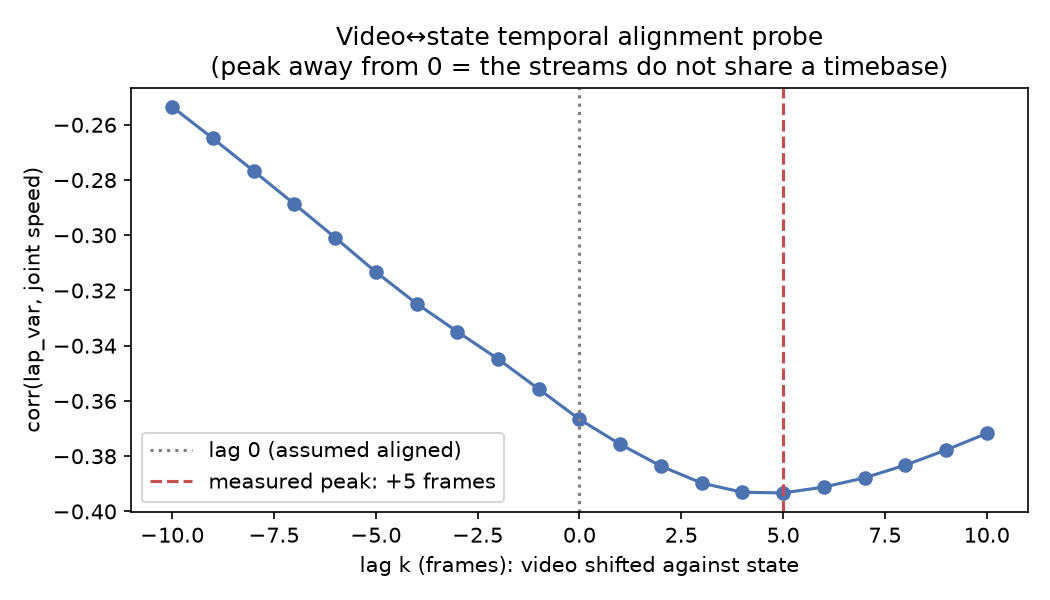
Five findings across 50 episodes, of which only two justify deleting data — the discipline being to remove data only when the fix is unambiguous and bias-free, and otherwise annotate and defer. The headline measurement: video lags state by 5 frames (100 ms) in every episode.
Labeling
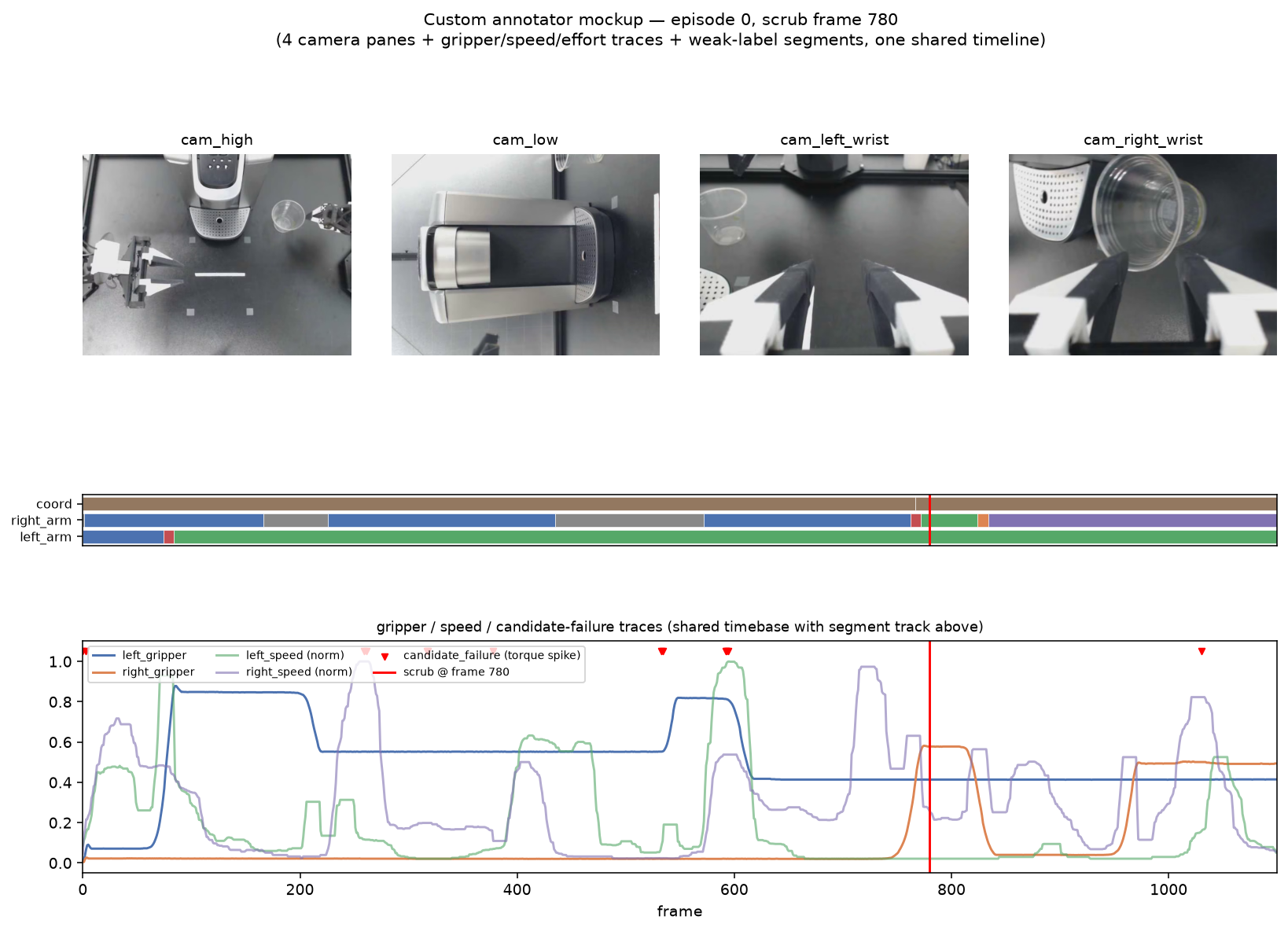
A three-level schema (episode / segment / frame) with a weak labeler proposing around 10 segments per episode with no human input, so annotators correct proposals instead of drawing boundaries from scratch. Inter-annotator agreement measured at tIoU 0.589.
Curation
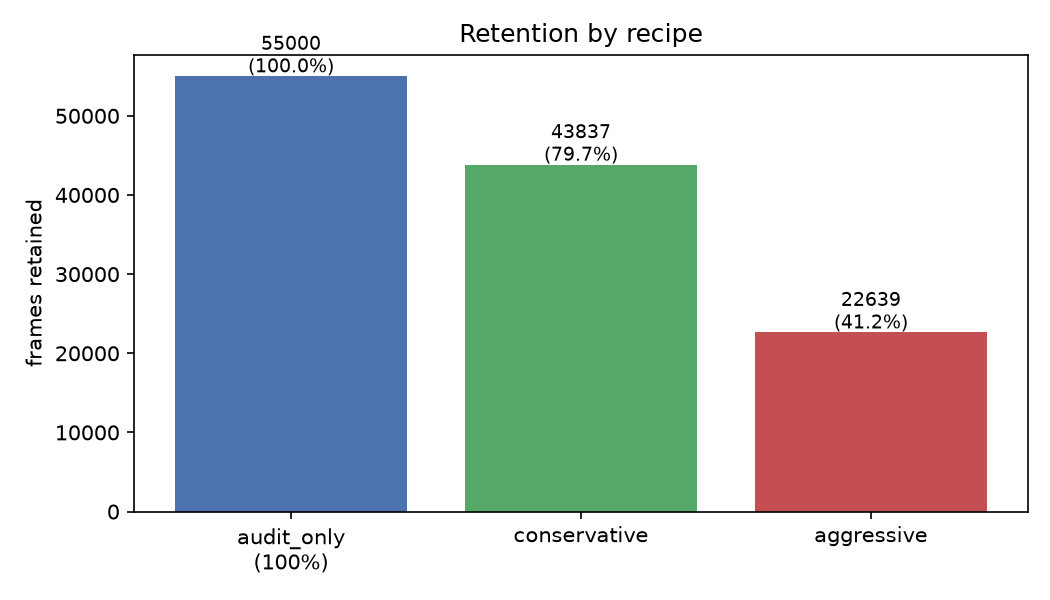
A config-driven filter registry implementing the audit findings one-for-one, producing a valid LeRobotDataset at 79.7% frame retention, with 16 tests covering alignment and synthetic corruption.
Evaluation and fine-tuning
The dataset carries no success label, so the evaluation protocol has to create one: three tiers, cheapest first, with a milestone success criterion and episode-level held-out splits. OpenVLA-7B was then fine-tuned both with LoRA and full-parameter for a full epoch. Both checkpoints ship with the action statistics needed to decode the model's bin indices back into joint targets — weights without that file are not a usable policy.
Mode Collapse in LLM Math Reasoning
March 2025 - June 2026 · KDD Group, ASU
Measured how models trained on synthetic math data lose diversity, by skeletonizing reasoning traces to strip numbers and variables, then clustering the remaining reasoning form. Paired with a GRPO training environment on Qwen3-4B to study how RL shifts that diversity.
Sim-to-Decision: MDN + LLM for Supply Chain Optimization
March 2025 - June 2026 · KDD Group, ASU
Pairs a learned simulator with an LLM decision maker: a Mixture Density Network and LSTM model the stochastic outcome of an action, and the LLM proposes decisions evaluated against that simulated world. Tested across four supply-chain datasets.
Computer Vision & Medical Imaging
Self-Supervised Dense Point Tracking in Turbulent Videos
August 2024 - December 2024
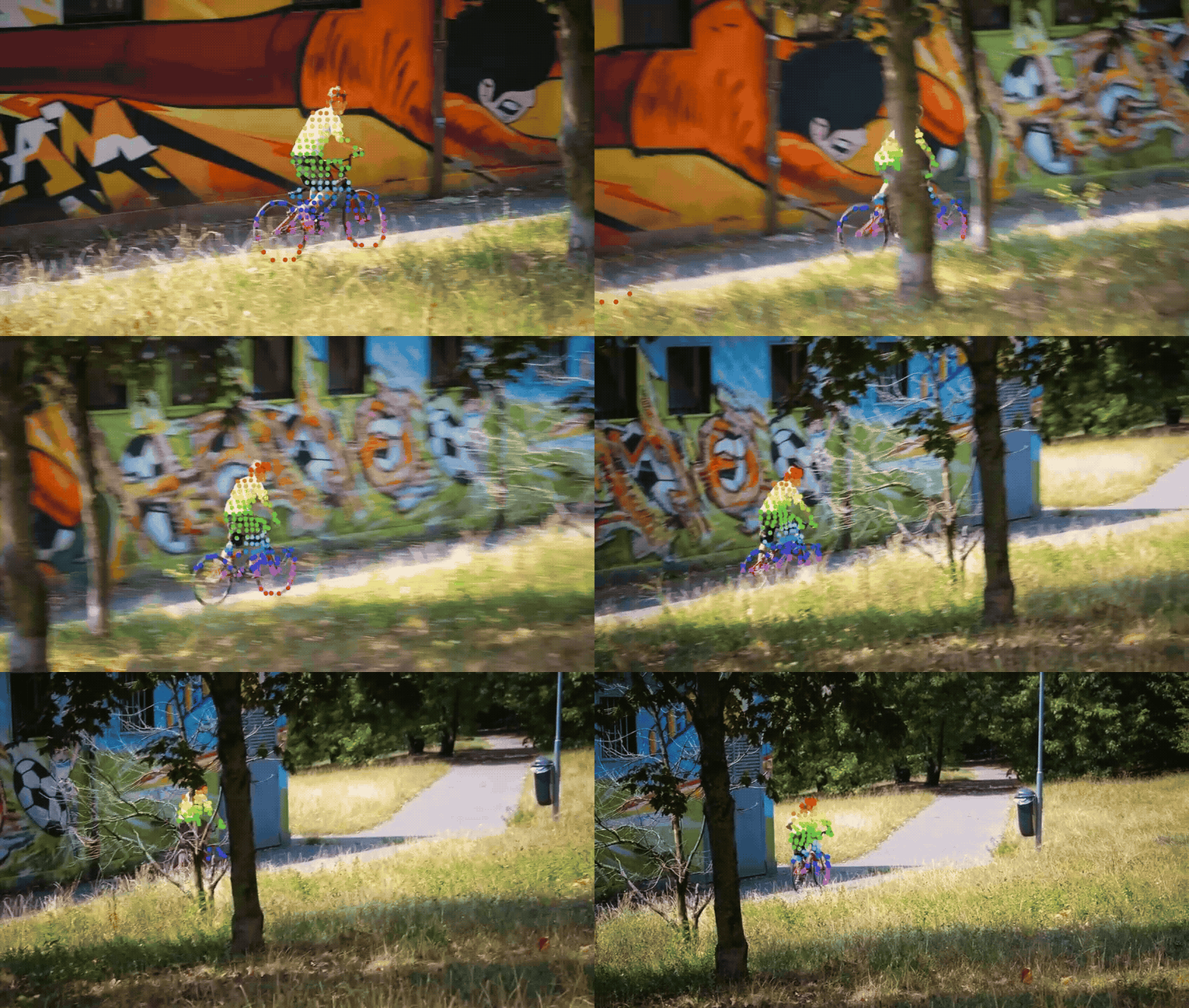
A benchmark for point tracking in videos with induced atmospheric turbulence. Enhanced DINO-Tracker with RAFT-based optical flow refinement and diagnosed its robustness gaps — a 32% average-Jaccard drop under moderate turbulence, with failures concentrated in occluded, high-blur frames.
Swin Transformer for Vision Tasks
August 2024 - December 2024
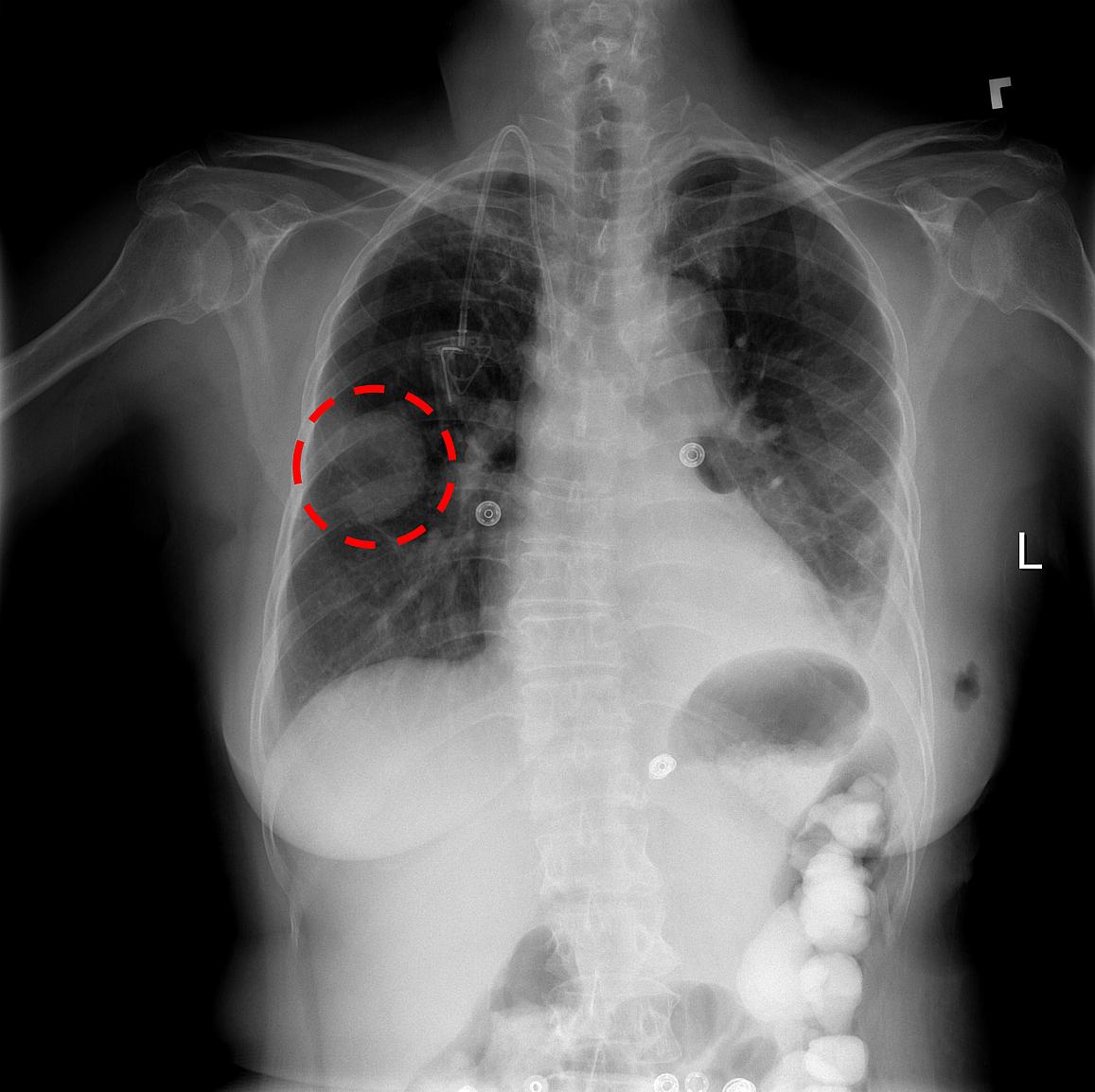
Classification, localization and segmentation on ChestXRay14, NODE21 and ChexMask. Reached 72.64% accuracy training from scratch and 81.78% fine-tuning from ImageNet on ChestXRay14 classification.
Comparative Study of Video Retrieval Methods
August 2024 - December 2024
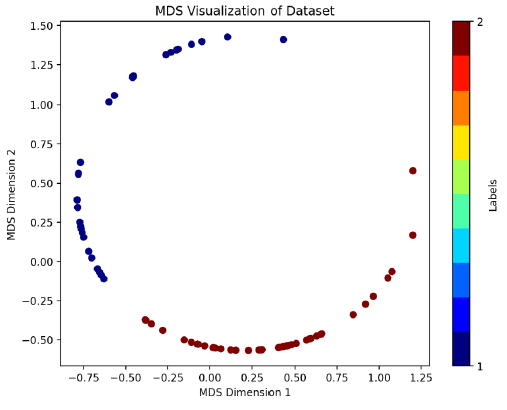
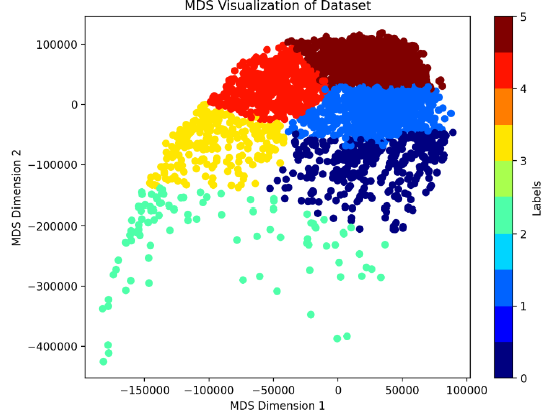
Applied PCA, SVD, LDA and K-Means to ResNet, HOG, HOF and colour-histogram feature spaces to rank and retrieve videos by similarity, with centroid-based ranking showing SVD best preserves latent structure.
Metamorphosis Automation
Aug 2020 - May 2021
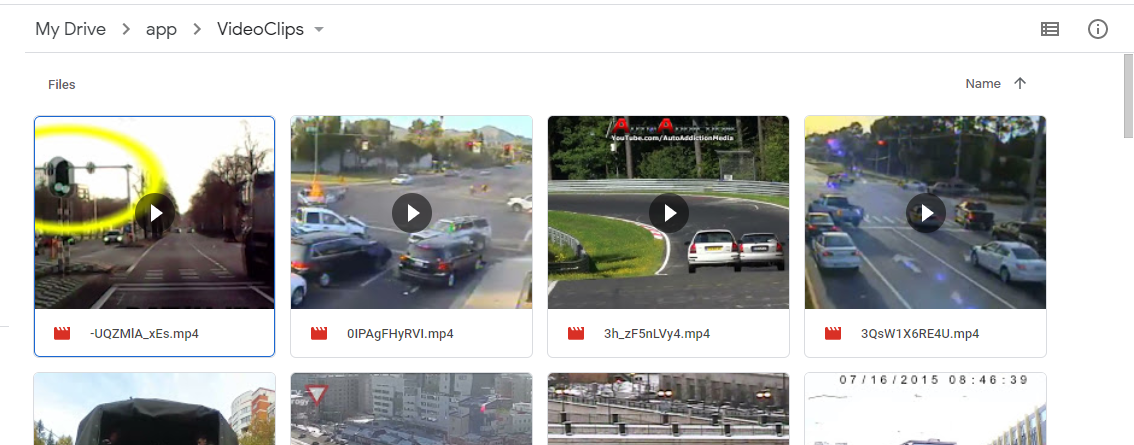
A ResNet-34 model detecting car accidents from real CCTV footage, wired into a pipeline with a REST API and Android/web dashboards that deliver real-time, geo-tagged accident alerts.
Cloud & Edge Computing
Edge-Based Face Recognition Pipeline using AWS IoT Greengrass
April 2025 - May 2025
A distributed face recognition pipeline across AWS IoT Greengrass, MQTT, Lambda and SQS — MTCNN detection running on simulated edge devices, FaceNet recognition triggered in the cloud, with device-to-cloud traffic secured through IoT Core policies and certificates.
Serverless Face Recognition Pipeline with AWS Lambda & ECR
March 2025 - April 2025
Serverless ML inference on streaming video frames: containerized Lambda functions for MTCNN detection and FaceNet recognition deployed via ECR, decoupled by SQS between the two stages.
Cloud-Based Face Recognition System Architecture and Optimization
February 2025 - March 2025
A scalable face recognition system on AWS using S3, SQS and dynamic EC2 instances, with a Python web tier, a PyTorch inference tier, and an auto-scaling controller that provisions on demand and holds zero idle instances.
Mobile & Web Development
mShare
August 2020
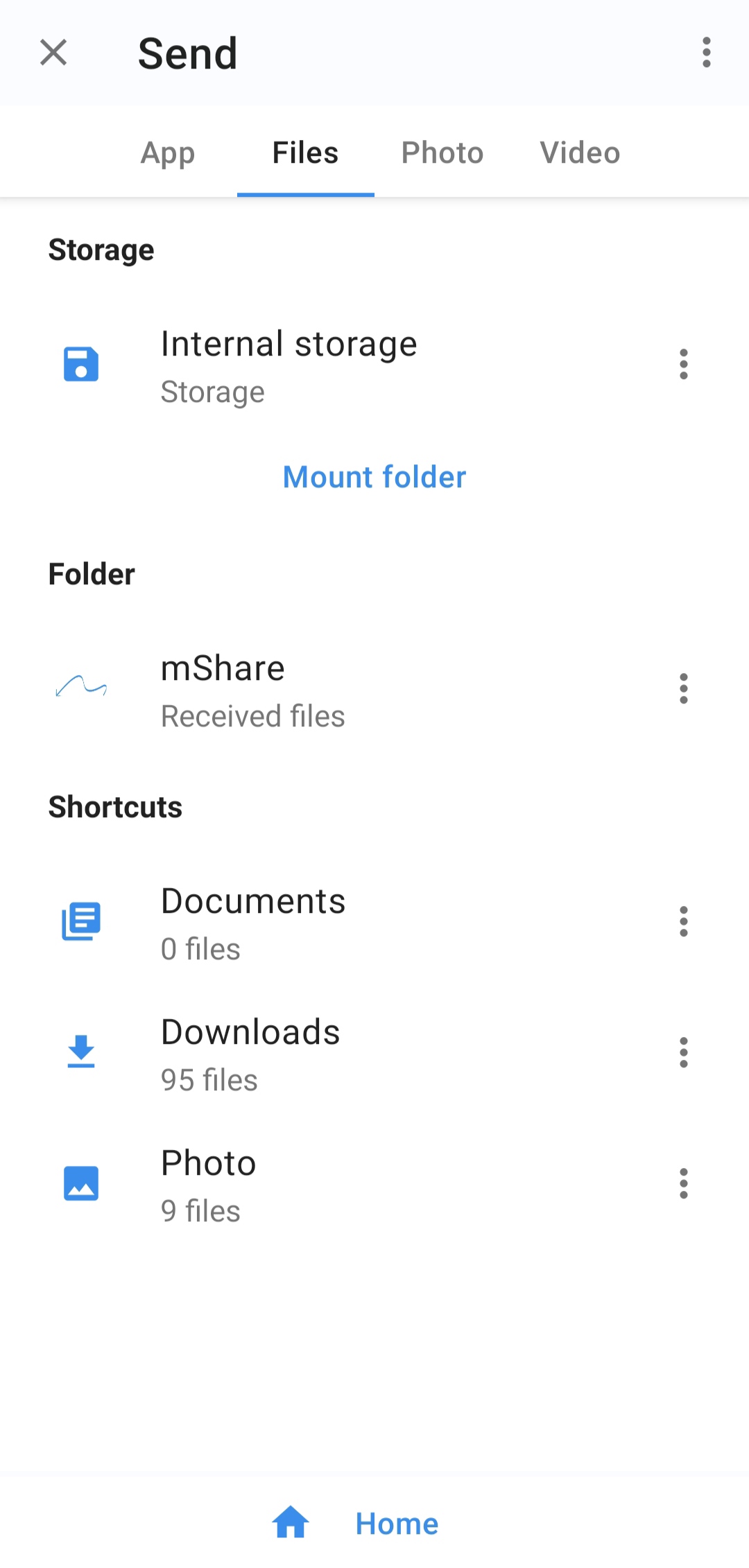
A file-sharing app published on the Google Play Store: high-speed offline transfer over hotspot and QR code, with pause/resume, multi-device sharing and automatic reconnection on network changes, tuned to stay fast on low-end Android devices.


COVFeed
Jun 2020
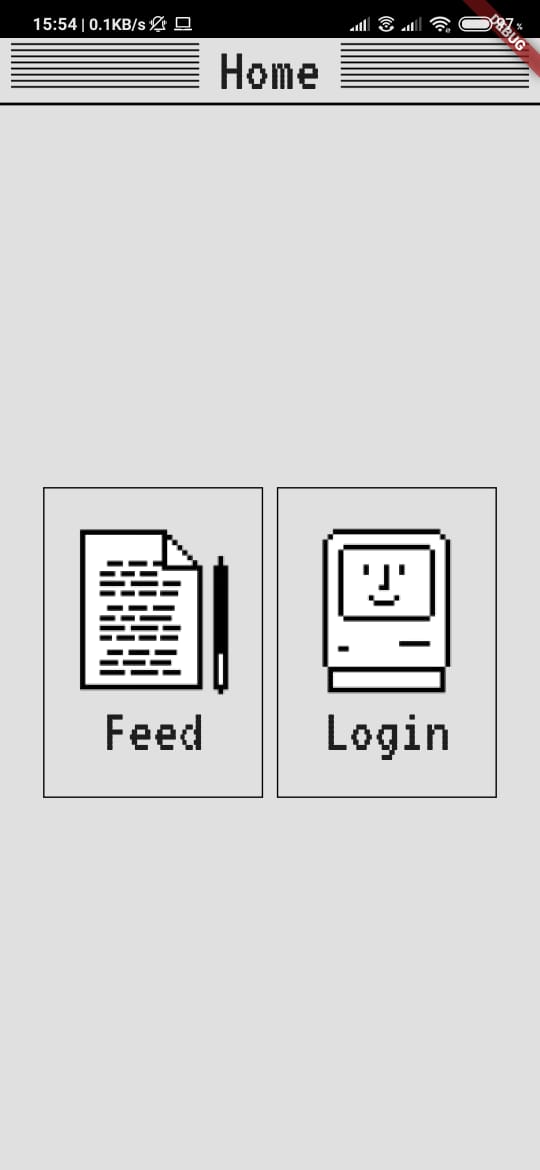
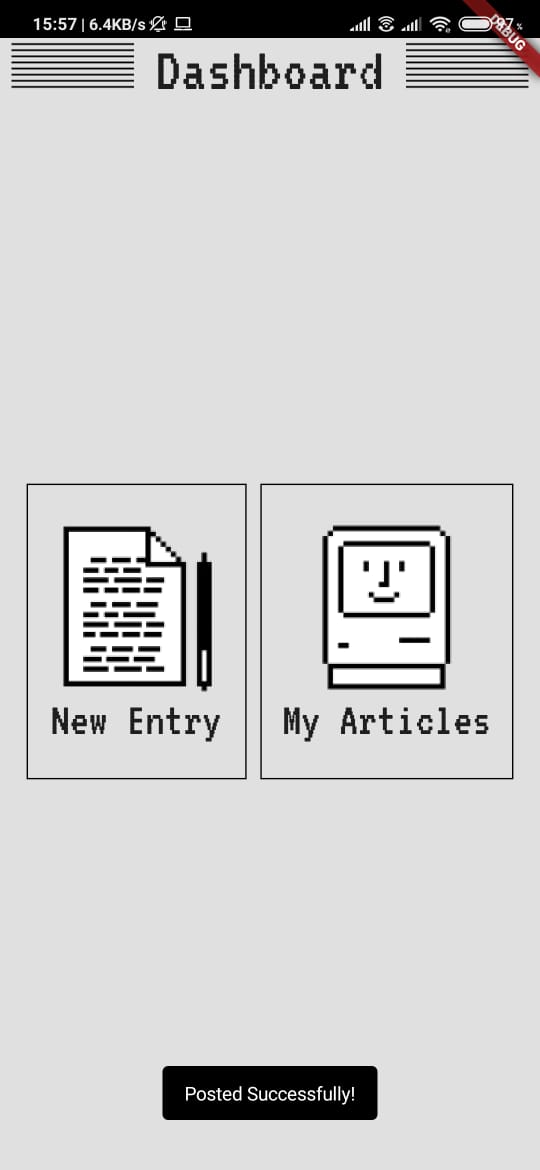
A Flutter app built in a team of two for the International Flutter Hackathon — a semi-news platform where doctors, nurses and medical staff shared real-time regional health updates during the COVID-19 pandemic.

HabitUp — Habit Tracking App
March 2022 - June 2022 · Software Development Engineer (Intern), Remote
• Built a habit tracking Android application with the Flutter framework and shipped it to the Google Play Store.
• The published app went on to support over 100,000 users tracking their habits.
ML Web Apps — Toxic Comments & Movie Ratings
February 2021 - April 2021 · Machine Learning Engineer (Intern), Technocolabs
• Toxic Comments Classification — a Flask web app serving a model that sorts comments into toxicity categories, deployed on Heroku.
• Movie Rating Prediction — a Flask web app predicting movie ratings, built as the major project while leading a team of five, also deployed on Heroku.
Contact
Feel free to reach out to me if you have any questions, opportunities, or just want to connect!
Location:
Tempe, AZ, USA